Microwave Not Heating: Fuse, Door Switch and Parts
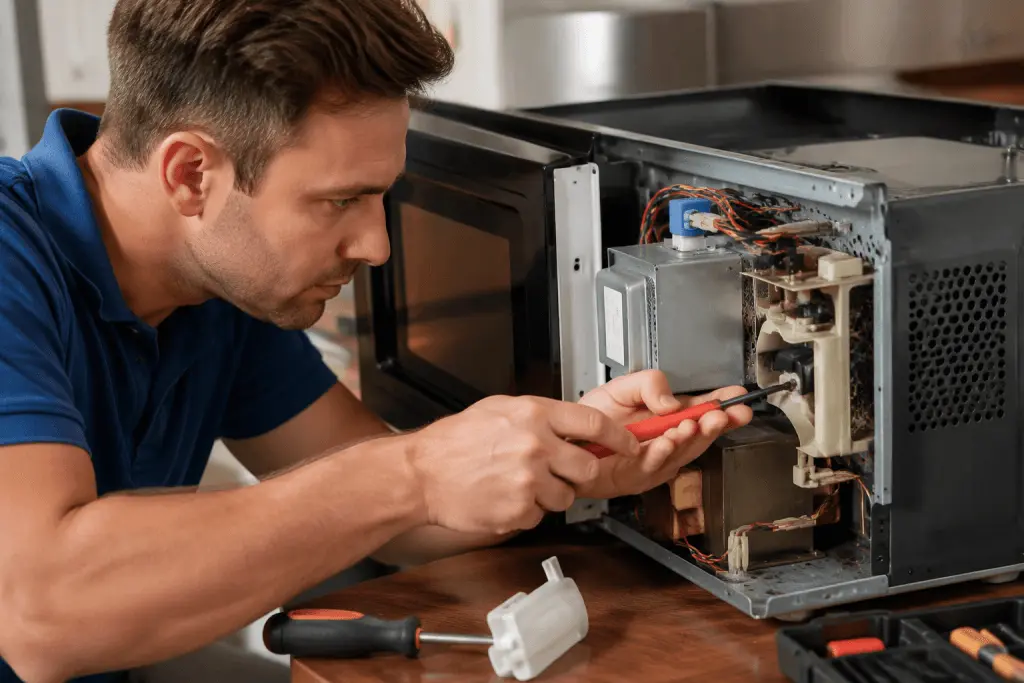
A microwave not heating is annoying when it still turns on, spins the plate and lights up, and the possible faults range from a cheap switch to a part that is not worth fixing. This guide helps you work out which side of that line you are on, and tells you where the safe checks end.
Table of Contents
A safety note first
With a microwave not heating, the temptation is to open the case. Inside is a high-voltage capacitor that can hold a dangerous charge after the unit is unplugged, and the U.S. Consumer Product Safety Commission warns about the electrocution hazard of do-it-yourself microwave repairs. Opening the case is for technicians. Everything in the safe checks below can be done without removing a panel.
Safe checks for a microwave not heating
- Test with water. Put a cup of water in the microwave and run it for one minute. Do not run it empty. If the water barely warms, the heating circuit is not working.
- Check the power level. It sounds basic, but someone may have set it to a low level, or the unit may be in a demo mode.
- Look at the door. Does it latch fully? Is the latch broken, or is there food on the seal? A door that doesn’t close correctly can keep the unit from running or cause it to run without heating.
- Check the display. Error codes, a blank display or unresponsive buttons point to a control board rather than a heating part.
- Listen. A normal microwave has a low hum when heating. If you hear the fan and turntable but not the hum, the high-voltage side is not firing.
What each failed part looks like
A microwave not heating usually traces back to one of these parts.
| Part | Typical symptom | Notes |
|---|---|---|
| Door switches | Dead entirely, or runs only if you press on the door | Small parts, but replacement is a technician job |
| Thermal fuse or high-voltage fuse | No power, or powers on but no heat | A blown fuse can be a sign of something else failing, such as a shorted diode |
| High-voltage diode | Runs, no heat, sometimes a loud hum | Capacitor danger, technician only |
| Magnetron | Runs, no heat; buzzing or sparking | Usually the most costly part |
| Control board | Buttons dead, erratic display | Cost depends on the model |
Why a fuse matters
Do not replace a blown fuse with a bigger one, and never bridge it with wire. The fuse blows to protect the circuit, and a repeat blow usually means a failed component behind it. On a microwave not heating, a technician tests the diode, capacitor and magnetron before fitting a new fuse.
Sparks, burning or smells
Stop and unplug the microwave if you see arcing, smell burning, or see a burn mark inside the cavity. Small sparks are sometimes caused by metal in the unit, a gold-rimmed plate, or a damaged waveguide cover (a stiff paper-like panel on the side wall). A greasy, cracked or burnt waveguide cover can be replaced, but if the sparks persist the magnetron may be damaged. Do not use it.
Repair or replace?
The decision on a microwave not heating depends on:
- The type. A countertop unit is usually cheaper to replace than a major repair. Over-the-range and built-in units are harder to swap out, and repair is often more attractive.
- The failed part. A door switch or fuse is a different decision from a magnetron.
- The age and condition. A microwave with a worn interior and failing control board is a poor candidate for a larger repair.
With a microwave not heating, ask for the diagnosis before deciding, and if you do replace it, see appliance installation for built-in and over-the-range units. We list what we cover on our microwave repair page. If it is a built-in, appliance disposal may help with the old one.
Care that makes it last
- Wipe spills promptly. Food baked on near the door seal and the waveguide cover causes arcing.
- Cover food so splatters do not build up.
- Do not run it empty or with metal in it.
- Steam a bowl of water with lemon for a few minutes to loosen grime, then wipe.
- Do not slam the door; the latches and switches take most of the wear.
- Keep the vents clear, especially on an over-the-range unit where the grease filter collects kitchen grease.
When to stop
- The door is bent, will not latch or the seal is damaged. Do not use it.
- Sparks, smoke or a burning smell.
- You are about to remove the cover.
If you would rather have it looked at, book at /book/ or call (916) 582-7791 and ask for the next available window. The service call is $80, paid at your home or with PayPal or a credit card.
Common questions
Why does my microwave run but not heat?
Commonly a failed high-voltage diode, a blown fuse or a failed magnetron. A technician can test these safely.
Is it safe to open a microwave to check the fuse?
No. The high-voltage capacitor can hold a dangerous charge even when unplugged. Leave it to a technician.
How do I test if my microwave is heating?
Run a cup of water for one minute. Never run the microwave empty. If the water stays cold, the heating circuit is not working.
Is it worth repairing a microwave?
It depends on the type and the failed part. A door switch is a different decision from a magnetron, and a countertop unit costs less to replace than a built-in.
Related guides
Appliance Disposal in Sacramento: Your Options for Getting Rid of an Old Unit
Retailer haul-away, city and utility programs, scrap yards and refrigerant rules: how to dispose of an old appliance in the Sacramento area.
Oven and Range Cooking Unevenly: Causes and Fixes
Hot spots, one side browning faster, or burnt bottoms: the usual causes of uneven oven heating and what to check first.
Getting Your Appliances Ready for a Sacramento Summer
Sacramento summers are hot and dry. A before-summer checklist for your fridge, freezer, ice maker, dryer and washer, with safe tests.