
Freezer Not Freezing or Icing Up: What to Check
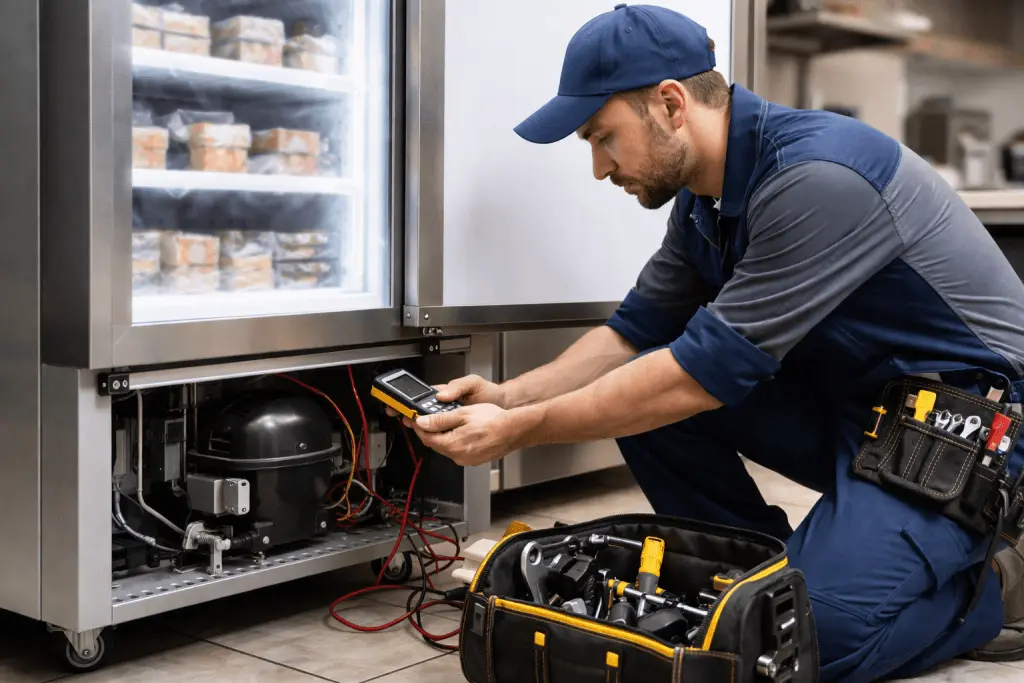
A freezer not freezing properly and a freezer that is icing up are often the same problem seen from two sides. The cure depends on whether the unit has stopped cooling or is cooling but building frost. Start by working out which.
First, test the temperature
Put an appliance thermometer between frozen packages. It should read about 0°F. Ice cream that is soft but not melted usually means the freezer is somewhere between 5°F and 15°F, which tends to point to airflow, door or setting issues. Everything thawed means a failure.
Safe checks for a freezer not freezing
- Power and controls. Confirm the unit is plugged in and the dial or panel has not been bumped. A chest freezer in the garage is often knocked or unplugged by accident.
- Door or lid seal. Close the door on a strip of paper. If it slides out easily, the seal is weak. Check also that the lid or door fully closes, with no frost build-up or a basket stopping it shutting.
- Heat and space. A freezer in a hot garage works much harder, especially in Sacramento summers. Leave a few inches of space around it. The U.S. Department of Energy’s Guide to Kitchen Appliances has general upkeep advice for refrigerators and freezers.
- Loading. Packing it with a lot of warm food at once raises the temperature for hours. Leave gaps so air can move, and do not block the vents in an upright or fridge-freezer.
- Coils. Unplug the unit and clean the condenser coils with a brush and vacuum, as described in refrigerator maintenance. The same applies to a standalone freezer.
Frost buildup: the defrost system
Most frost-free freezers heat the evaporator coil briefly every several hours to melt frost, and the water drains away. When one part of that system fails, frost grows over the coil until air cannot pass, and you end up with a freezer not freezing even though it runs. The usual suspects are:
- The defrost heater, which burns out.
- The defrost thermostat or sensor, which tells the heater when to stop.
- The control board or timer, which starts the cycle.
- A clogged defrost drain, which lets the melt water refreeze at the bottom.
The sign is a thick layer of frost on the back wall of an upright, or a freezer that seems fine for days after a manual defrost and then slides again. Manual-defrost chest freezers are different: they are meant to frost up, and need defrosting when the ice is about a quarter inch thick.
Manual defrost, safely
- Unplug it. Move the food to coolers.
- Leave the door open, with towels and a shallow pan underneath. A pan of hot water speeds it up.
- Never chip the ice with a knife or screwdriver, because the evaporator tubing can be punctured.
- Wipe it dry before plugging in.
If the freezer works fine for a few weeks after and then frosts again, the defrost system is failing, not the seals.
Freezer cold on top but warm below, or fridge warm and freezer cold
That points to airflow. In a fridge-freezer, the freezer fan pushes cold air to both compartments. If it is stuck, the fridge warms. See refrigerator not cooling.
Compressor and sealed-system signs
If you have a freezer not freezing at all and the unit hums or clicks and shuts off repeatedly, or the compressor is very hot, the problem may be a start relay or the compressor itself. Both are worth a technician because a refrigerant circuit can only be opened by someone trained for it. Do not keep power-cycling it.
What to do with the food
While you sort out a freezer not freezing, keep the door closed. A full freezer holds frozen food for around 48 hours, a half-full one for about 24, according to the USDA. Food with ice crystals still in it can be refrozen; anything above 40°F for more than two hours should go.
When to stop
- The unit smells of burning or the cord is hot.
- You see an oily residue near the coils.
- The frost returns after a manual defrost.
- You are considering opening a back panel while the freezer is plugged in.
If your freezer not freezing turns out to be one of the defrost parts, a technician can identify it quickly. See our freezer repair page for what we do, and why timely repairs matter for the reasons not to wait on a failing freezer.
If you would rather have it looked at, book at /book/ or call (916) 582-7791 and ask for the next available window. The service call is $80, paid at your home or with PayPal or a credit card.
Common questions
Why is my freezer not freezing but the fridge is fine?
Common causes are a blocked vent, a failed evaporator fan, heavy frost over the coil, or a damper stuck partway shut. Check for packed vents first.
How cold should a freezer be?
0 degrees F. Use a thermometer, not the dial numbers.
Can I refreeze food that thawed?
If it still contains ice crystals or is at 40 degrees F or below, it is generally safe to refreeze, although quality may drop. If it was above 40 for over two hours, throw it out.
Why does my freezer keep icing up after I defrost it?
If the seal is good, the likeliest cause is a failed defrost heater, thermostat or control board, or a clogged drain.
Related guides
Appliance Disposal in Sacramento: Your Options for Getting Rid of an Old Unit
Retailer haul-away, city and utility programs, scrap yards and refrigerant rules: how to dispose of an old appliance in the Sacramento area.
Microwave Not Heating: Fuse, Door Switch and Parts
When a microwave runs but does not heat, the cause is usually a fuse, door switch or high-voltage part. Here is what to check…
Oven and Range Cooking Unevenly: Causes and Fixes
Hot spots, one side browning faster, or burnt bottoms: the usual causes of uneven oven heating and what to check first.